


In most cases, men face chronic congestive prostatitis, the development of which is caused by poor circulation and thickening of prostate secretions.This form of inflammation is considered a disease of older men.In about 20% of cases, patients in urological clinics are diagnosed with bacterial prostatitis - an acute form of inflammation of the prostate that does not depend on age and is caused by the action of pathogenic microorganisms.
Causes of the development of bacterial prostatitis

As the name of the diagnosis makes clear, the cause of the disease is bacteria that penetrate the prostate gland via lymphogenous or hematogenous routes.
Infection of the prostate with lymph flow occurs with the development of various inflammatory diseases of the genitourinary system.
Through the bloodstream, the infection enters the prostate against the background of serious infectious diseases such as influenza, acute tonsillitis or pneumonia.
Most often, pathogenic microorganisms enter the prostate through the urethra.Infection occurs against the background of diseases of the genital organs.
In bacterial prostatitis, the causes lie in the action of pathogenic microbes, but great importance is attached to the general condition of the body, since the disease develops only with reduced immunity.Reasons for weakening the protective function of the body:
- hypothermia;
- vitamin deficiency due to an unbalanced diet;
- antibacterial therapy;
- stress;
- physical inactivity;
- chronic focus of infection;
- bad habits;
- long-term sexual abstinence;
- promiscuity.
The disease is characterized by acute symptoms that increase rapidly.Unlike congestive prostatitis, bacterial inflammation is not age-dependent and occurs in young men.
types of disease
Bacterial prostatitis is distinguished by the type of pathogen and the degree of involvement of prostate tissue in the inflammatory process.
Most often, prostatitis is caused by staphylococcus.This form of the disease is characterized by the formation of ulcers in the prostate tissue, accompanied by an increase in temperature and release of pus from the urethra or anus.This form of the disease can be a complication of influenza, pneumonia or a consequence of the presence of a chronic source of infection in the body.
Among the opportunistic microorganisms that cause prostatitis, Escherichia coli and Pseudomonas aeruginosa occupy the first place in prevalence.This form of the disease develops against the background of decreased immunity.Pathogenic microorganisms enter the prostate gland via the lymphogenous route.
Chlamydial prostatitis is a consequence of promiscuity.A partner's chlamydia infection is asymptomatic, but due to a decrease in immune defenses, bacteria can enter the prostate gland and cause inflammation.
One of the most serious forms of bacterial prostatitis is inflammation due to fungi or candida.It develops when fungi of the genus Candida penetrate the prostate gland.The disease develops slowly and may not have significant symptoms for a long time.Often the fungal form of inflammation develops into chronic prostatitis.
Treatment of abacterial prostatitis caused by fungal microflora requires an integrated approach, since fungi quickly develop resistance to the action of antifungals.
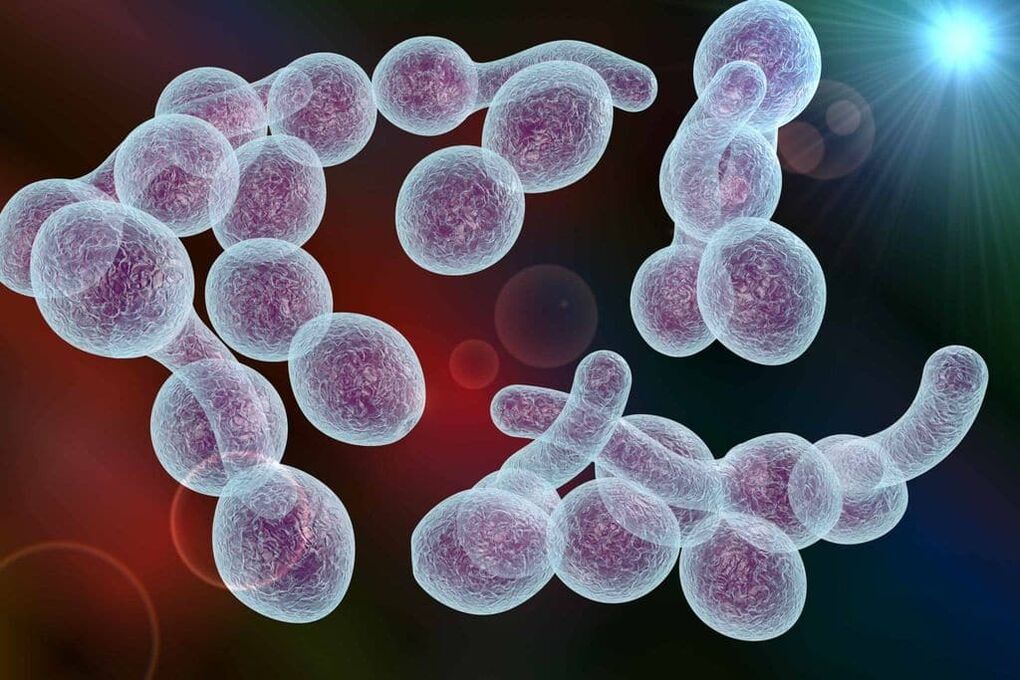
Candida does not show its presence for a long time and is difficult to treat.
Acute bacterial prostatitis may be accompanied by the formation of purulent foci.There are several types of diseases, depending on the degree of involvement of the prostate tissue in the inflammatory process:
- catarrhal;
- follicular;
- parenchymatous;
- prostate abscess.
The catarrhal form is characterized by inflammation of the walls of the prostatic ducts.It is a mild form of inflammation and can be successfully treated with antibiotics in a week and a half.
Follicular prostatitis is accompanied by the formation of ulcers in the glandular tissue.This form of the disease is manifested by high fever, but is treated quite effectively with antibiotics.
With parenchymal inflammation, the pathological process spreads to the entire organ.At the same time, the prostate increases in size, its contours change, and swelling develops.In the absence of timely treatment, this form of the disease can develop into chronic prostatitis.
A prostate abscess is the formation of a pus-filled cavity.Due to the abscess, high fever and symptoms of poisoning occur.When an abscess ruptures, immediate relief occurs, but the entry of purulent contents into the general bloodstream can lead to sepsis.This form of the disease is characterized by acute pain, elevated body temperature and severe intoxication of the body.The abscess is opened surgically.
The listed types of diseases also act as stages of the development of acute bacterial prostatitis.In the absence of timely treatment, one stage passes into another, symptoms worsen and the risk of complications increases.
Symptoms of the disease
The symptoms of bacterial prostatitis depend on the stage of the inflammatory process.The initial stages of the disease are characterized by the following symptoms:
- pain in the bladder area;
- frequent need to go to the bathroom;
- pain after urinating;
- general malaise.
As bacterial prostatitis progresses, the symptoms intensify.Body temperature rises, pain increases, and problems urinating worsen.

In severe cases, severe poisoning is possible, accompanied by nausea and vomiting, loss of strength and dizziness.Body temperature can increase up to 40°C.
The frequency of the urge to go to the bathroom can reach up to 10 times per hour.In this case, the man feels that the bladder is full and after urinating there is no relief.
In particularly severe cases, acute urinary retention may develop.This is accompanied by a feeling of fullness of the bladder with a complete inability to empty it.This complication is very dangerous and requires hospitalization with subsequent installation of a catheter.
Frequent urination is caused by compression of the bladder by the inflamed prostate.
Why is prostatitis dangerous?
The danger of bacterial prostatitis lies in the risk of infection of the pelvic organs.If urination is disturbed, urine can back up, causing a kidney infection.This disease is called pyelonephritis and is difficult to treat.
One of the most common complications of bacterial prostatitis is cystitis, which becomes chronic.The disease is characterized by inflammation of the bladder mucosa and is accompanied by frequent need to go to the bathroom, spasms and pain in the bladder, and hematuria.
Untimely or inadequate treatment of bacterial prostatitis can cause the disease to become chronic.If acute bacterial prostatitis is successfully treated with antibiotics, the treatment of a chronic disease is aggravated by periodic exacerbations of symptoms, which occur against a background of decreased immunity.
Acute bacterial prostatitis can cause infertility and impotence.
The most dangerous complication is the penetration of an abscess into the prostate cavity.Purulent masses are carried by blood and lymph through the pelvic organs, causing inflammation of the rectum, bladder and kidneys.In especially severe cases, a ruptured abscess can lead to sepsis.
Diagnosis of the disease.
The primary examination of the prostate is a digital examination (rectal palpation).If bacterial prostatitis is suspected, when the patient presents symptoms of intoxication and elevated temperature, prostate massage is not performed to avoid the risk of worsening symptoms.
The diagnosis is made based on the results of ultrasound or TRUS.Treatment of bacterial prostatitis depends on the type of inflammatory agent.For this it is necessary to analyze the prostate secretion.Since rectal examination of the prostate is prohibited in case of acute inflammation, urine is taken for bacteriological analysis of the causative agent of prostatitis.It is also necessary to undergo a general and biochemical blood test.
Based on the results of a urine analysis, the doctor selects antibiotics and bactericidal drugs for the treatment of prostatitis.
Treatment of bacterial prostatitis.
The way to treat bacterial prostatitis depends on the type of pathogen.The choice of antibacterial therapy for prostatitis is made depending on the sensitivity of pathogens to the action of certain drugs.
Antibiotic treatment can be supplemented with the help of rectal suppositories, which are antibacterial and anti-inflammatory suppositories used for prostatitis.
Nonsteroidal anti-inflammatories, antipyretics with anti-inflammatory effects, and antispasmodics help reduce the signs and symptoms of bacterial prostatitis.These drugs do not cure prostatitis, but they reduce pain and alleviate the course of the disease.
Folk remedies
Having figured out how to cure the prostate with bacterial prostatitis with the help of medications, many will be interested in the possibility of alternative treatment.
Among the effective methods of treating prostatitis with folk remedies, the most effective are rectal suppositories with propolis.You can prepare them yourself.To do this, melt 200 g of cocoa butter in a water bath and add 40 g of crushed propolis to it.The mixture is boiled until the propolis dissolves and the mass acquires a uniform color and consistency.Then the medicine is cooled in the refrigerator, having previously formed a cone from the dough with cling film.After cooling, the cone is cut into small torpedoes, approximately 2 cm in diameter and 4 cm in length.Suppositories are stored in the refrigerator and used twice a day: in the morning and in the evening.The course of treatment lasts two weeks.
Walnuts and pumpkin seeds will help speed recovery.To prepare the medicine, grind 100 g of raw peeled nuts and seeds in a coffee grinder, and then mix with a glass of honey.From the resulting dough, balls are made, approximately 2-3 cm in diameter.You need to eat 3 of these balls every day.
Men are also recommended to eat nuts with honey.To prepare the medicine, a glass of chopped walnuts is mixed with honey and left for three days in the refrigerator.The remedy is then taken three large spoonfuls a day.
Prevention
Bacterial prostatitis is a dangerous disease that can become chronic.In most cases, timely treatment allows you to successfully get rid of the disease, but no man is insured against a repeated episode of prostatitis.To prevent the development of bacterial prostatitis, it is necessary:
- dress for the weather;
- avoid hypothermia;
- treat any infectious diseases in a timely manner;
- Protect yourself during sexual relations.
If you are receiving long-term treatment with antibiotics or corticosteroids, you should consult your doctor about how to prevent the immune system from deteriorating.
You should pay attention to your own immunity, since a weakening of the body's protective function leads to the development of an acute inflammatory process in the prostate.To do this, it is recommended to take an annual course of vitamins designed specifically for men, control your diet and avoid stress.